
Material description
Material ID: ACP05
Material type: Aluminium composite panel with a core consisting of polyethylene modified with vinyl acetate (PE-VA) and a fire retardant.
Polymer: Polyethylene modified with vinyl acetate (33%)
Additives (fire retardants, fillers or traces of inorganic elements): Magnesium Hydroxide (58%), Calcium Carbonate (7%), Silicon (1%), Titanium (1%), Sodium (1%), traces of other elements (<1%)
Core thickness: 3.12mm
Thickness of single metal skin: 0.5mm

| Compound | Mass Concentration (%) |
|---|---|
| Polyethylene modified with vinyl acetate (PE-VA) | 33 |
| Magnesium Hydroxide (Mg(OH)2) | 58 |
| Calcium Carbonate (CaCO3) | 7 |
| Silicon (Si) | 1 |
| Titanium (Ti) | 1 |
| Sodium (Na) | 1 |
| Traces of iron (Fe) | <1 |
| Traces of barium (Ba) | <1 |
| Traces of potassium (K) | <1 |
| Traces of aluminium (Al) | <1 |
A. Material composition identification
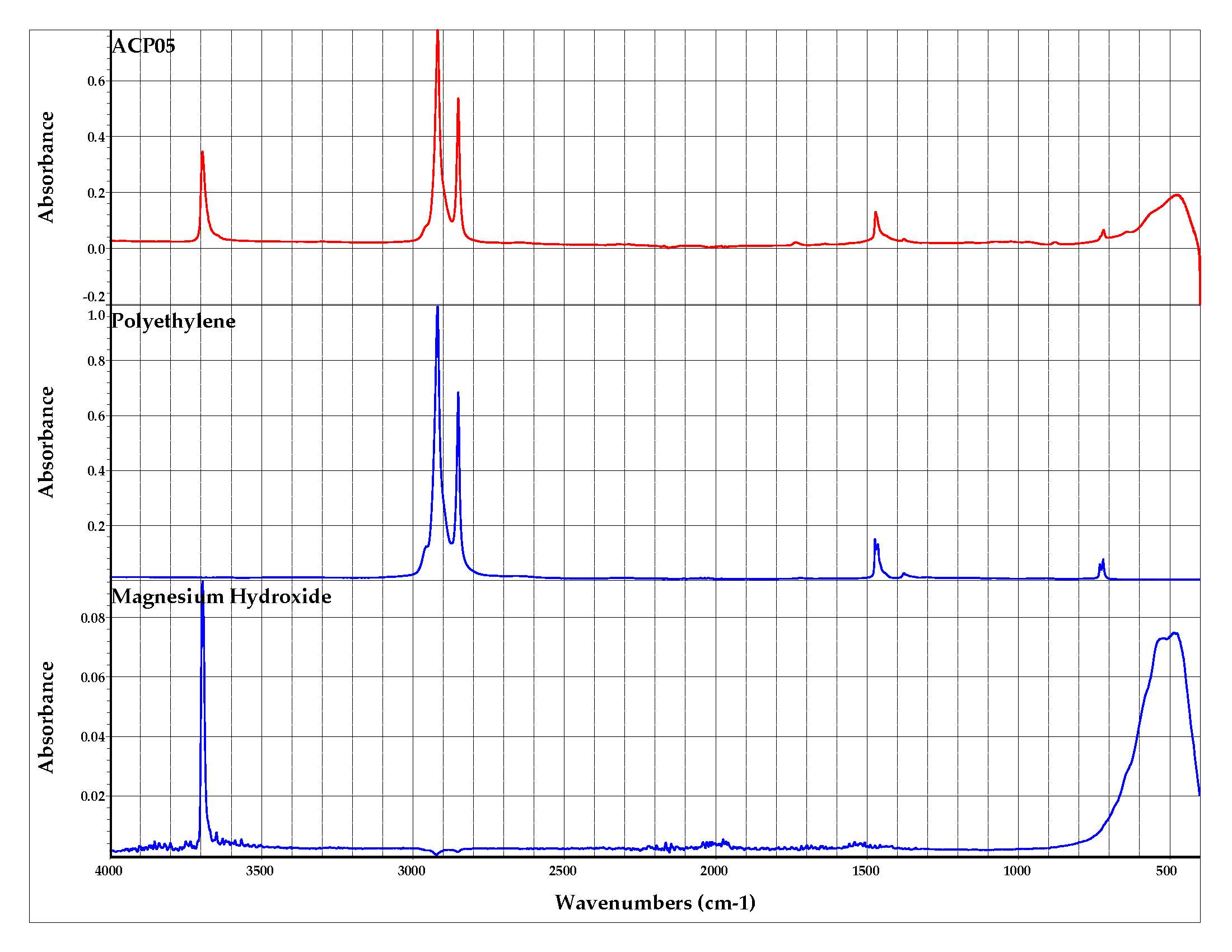
A.1 Attenuated total reflection – Fourier transform infrared spectroscopy (ATR-FTIR)
| Identified Compounds |
|---|
| Polyethylene modified with vinyl acetate (PE-VA) |
| Magnesium Hydroxide (Mg(OH)2) |
| Calcium Carbonate (CaCO3) |

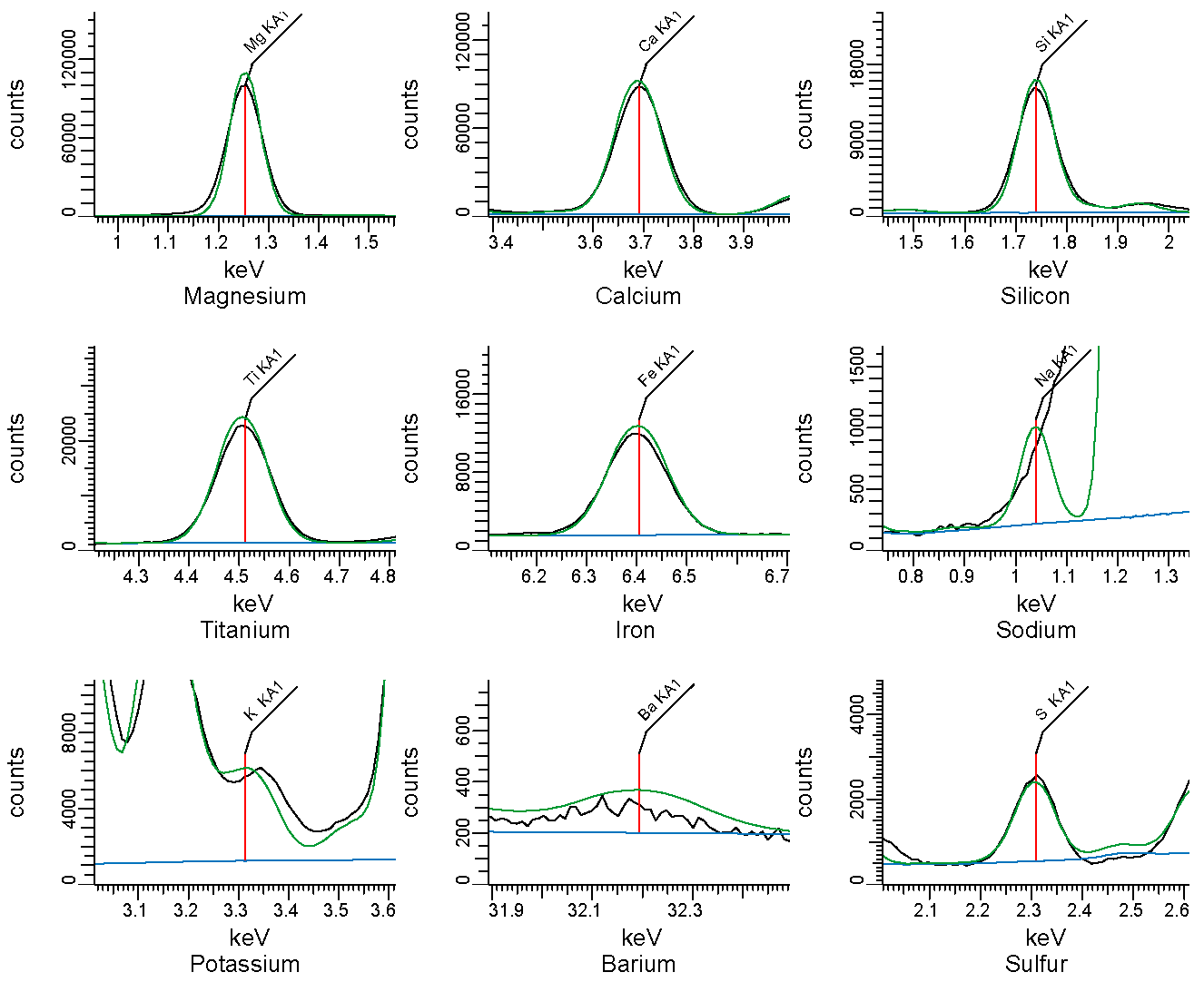
A.2 Energy Dispersive X-Ray Fluorescence (EDXRF)
| Element | Mass Concentration (%) |
|---|---|
| Mg | 21 |
| Ca | 5 |
| Si | 1 |
| Ti | 1 |
| Fe | <1 |
| Na | <1 |
| S | <1 |
| Ba | <1 |
| K | <1 |
| Al | <1 |
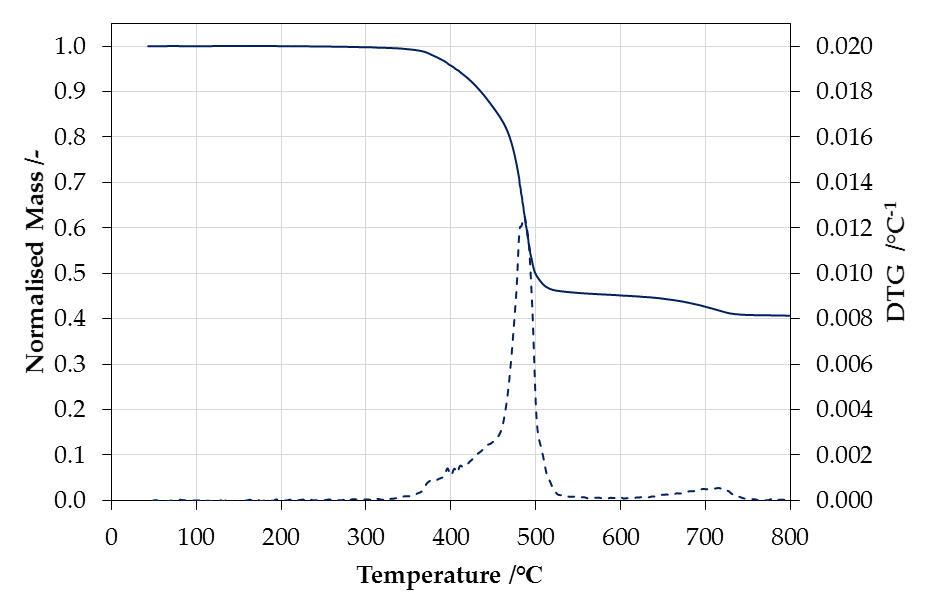
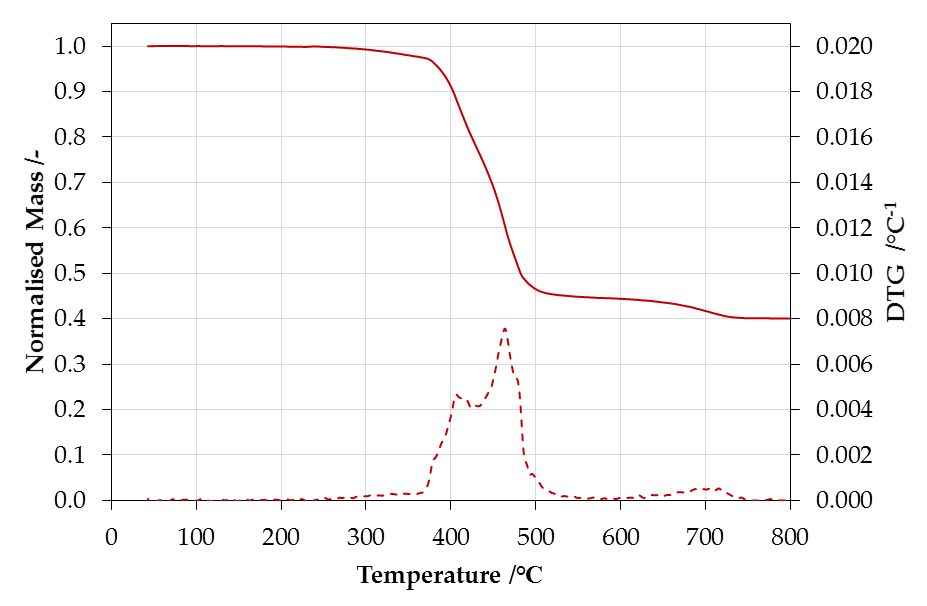
B. Thermogravimetric analysis
| Condition | Fraction of mass residue at 800°C |
|---|---|
| Non-oxidative (nitrogen) | 0.41 |
| Oxidative (air) | 0.40 |
| Peak ID | Temperature peak (°C) | Amplitude of peak (°C-1) |
|---|---|---|
| Peak 1 | 486 | 1.251 x 10⁻² |
| Peak ID | Temperature peak (°C) | Amplitude of peak (°C-1) |
|---|---|---|
| Peak 1 | 406 | 4.66 x 10⁻³ |
| Peak 2 | 464 | 7.56 x 10⁻³ |
C. Gross Heat of Combustion
| Trial | ΔHc [kJ g-1] |
|---|---|
| Trial 1 | 19.85 |
| Trial 2 | 19.73 |
| Trial 3 | 19.77 |
| Average | 19.78 |
| Std dev | 0.06 |
D. Ignition parameters
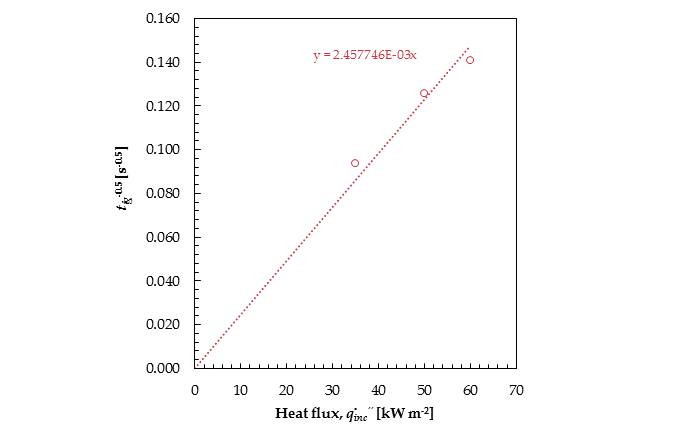
| Critical heat flux for ignition | Ignition temperature | Total heat transfer coefficient of losses | Apparent thermal inertia |
|---|---|---|---|
| q̇″cr [kW m−2] | Tig [°C] | hr [W m-2 K-1] | kρc [kW2 m-4 K-2 s] |
| 16.80 | 393 | 40.50 | 1.227 |
E. Burning behaviour
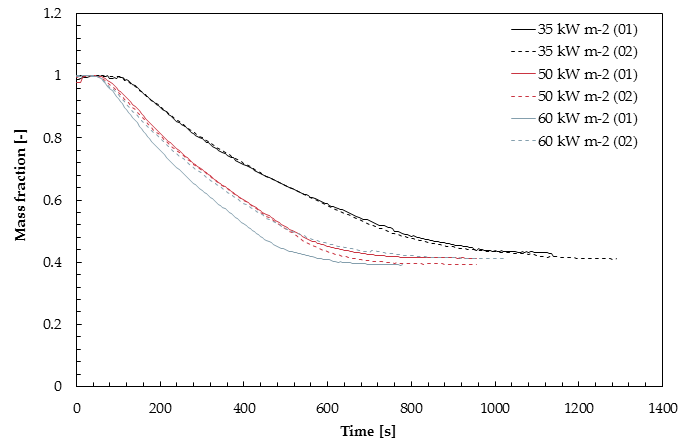
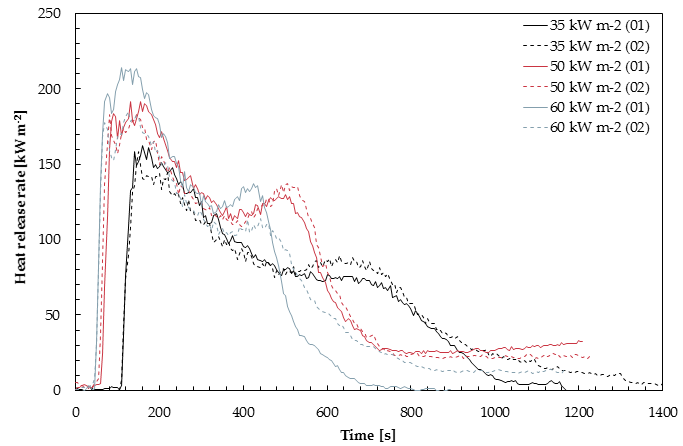
| Heat flux | Test | Time to ignition | Fraction of mass residue | Peak heat release rate | Total energy released |
|---|---|---|---|---|---|
| q̇″inc [kW m-2] | tig [s] | mres [-] | q̇″p [kW m-2] | Qt [MJ m-2] | 35 kW m-2 |
| Test 1 | 114 | 0.42 | 162.62 | 73.34 | |
| Test 2 | 113 | 0.41 | 158.34 | 78.52 | |
| Avg | 114 | 0.41 | 160.48 | 75.93 | 50 kW m-2 |
| Test 1 | 68 | 0.41 | 195.53 | 91.04 | |
| Test 2 | 59 | 0.39 | 183.79 | 84.12 | |
| Avg | 64 | 0.40 | 189.66 | 87.58 | 60 kW m-2 |
| Test 1 | 52 | 0.39 | 218.59 | 71.58 | |
| Test 2 | 49 | 0.41 | 189.66 | 77.07 | |
| Avg | 50 | 0.40 | 204.13 | 74.33 | 80 kW m-2 |
| Test 1 | - | - | - | - | |
| Test 2 | - | - | - | - | |
| Avg | - | - | - | - |
| Test | ΔHc [kJ g-1] |
|---|---|
| 35 kW m-2 (Test 1) | 30.85 |
| 35 kW m-2 (Test 2) | 32.50 |
| 50 kW m-2 (Test 1) | 37.62 |
| 50 kW m-2 (Test 2) | 34.56 |
| 60 kW m-2 (Test 1) | 29.71 |
| 60 kW m-2 (Test 2) | 29.41 |
| 80 kW m-2 (Test 1) | - |
| 80 kW m-2 (Test 2) | - |
| Average | 32.44 |
| Std dev | 3.18 |
F. Flame Spread
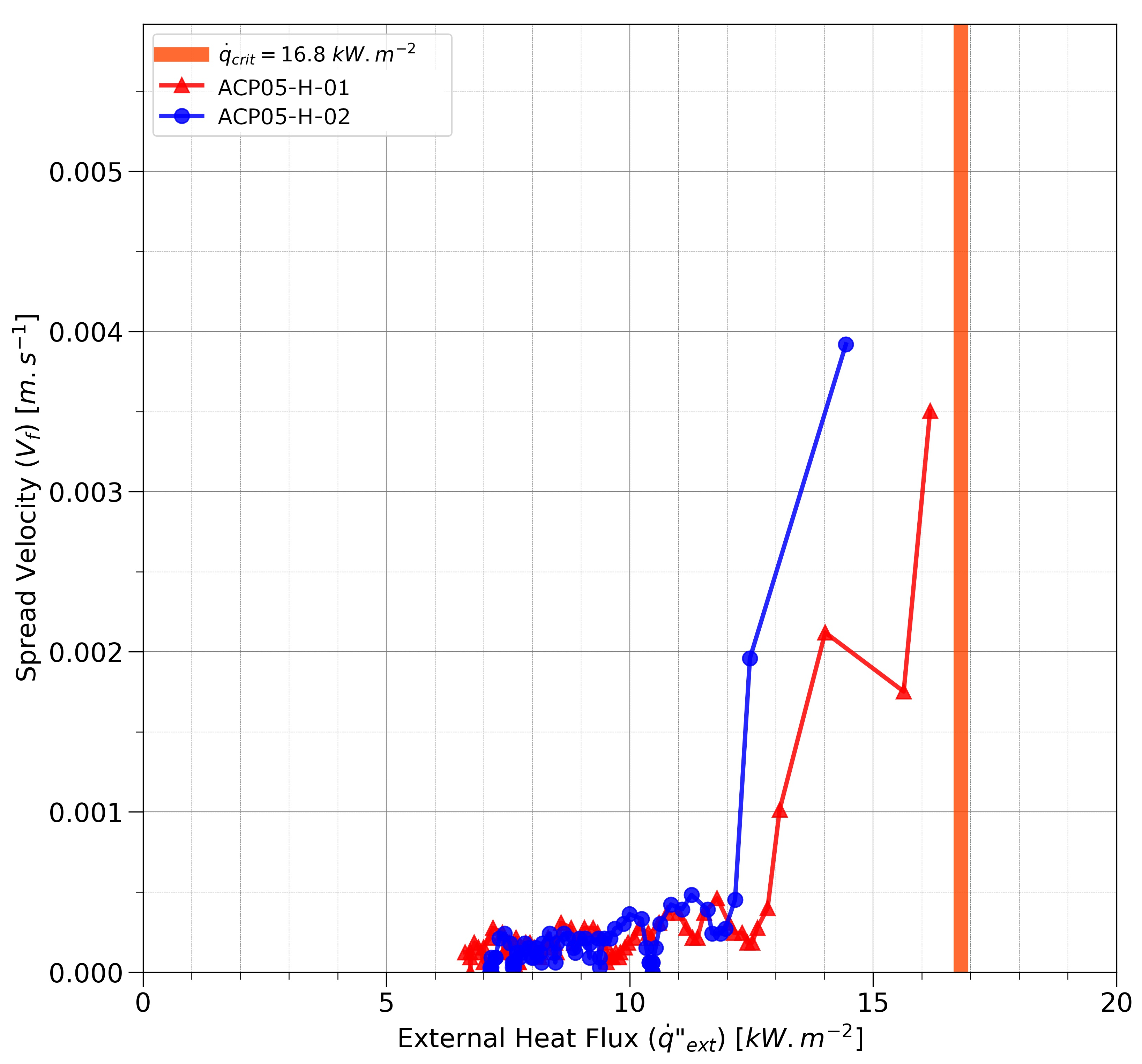
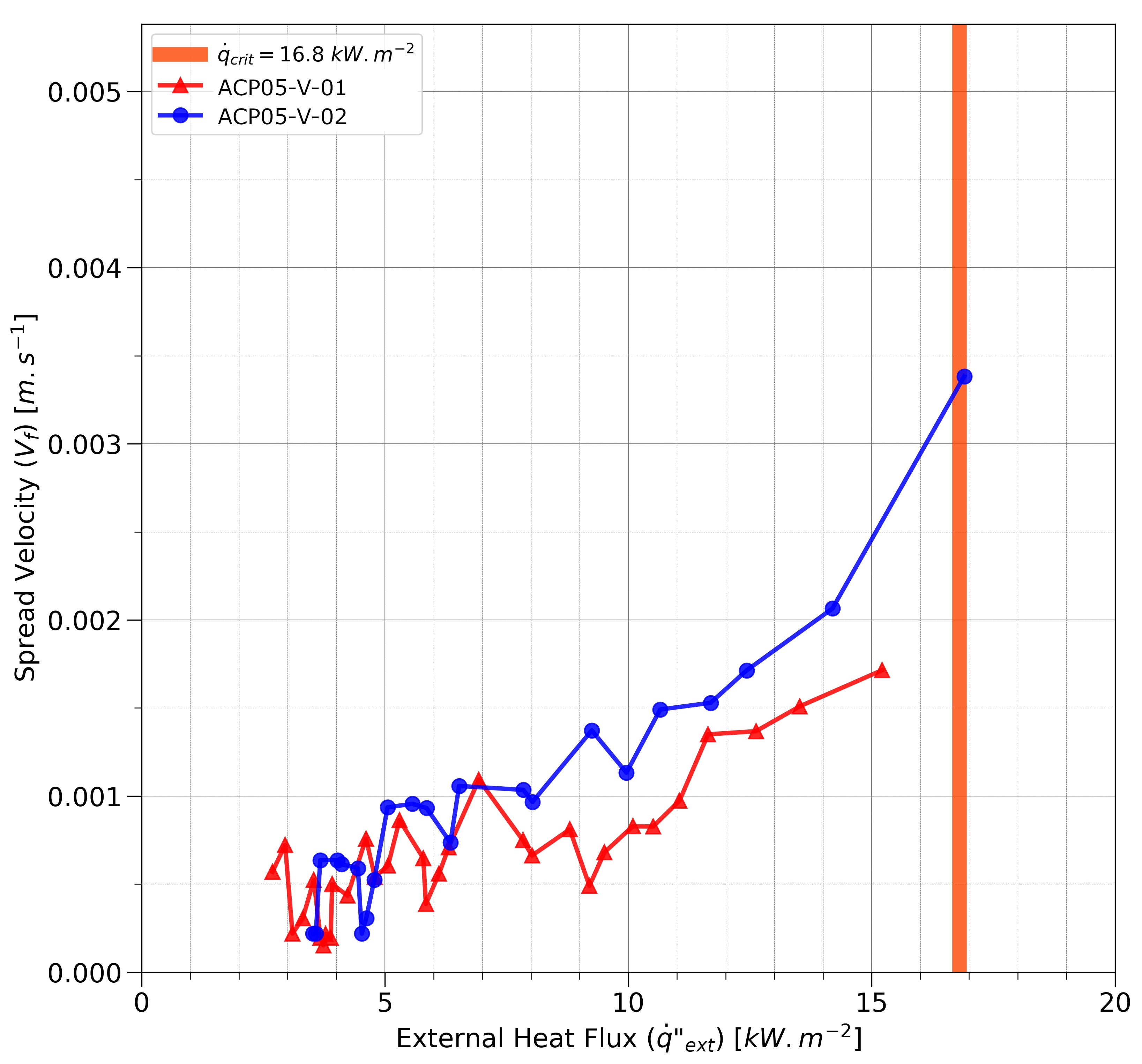
| Orientation | q̇″min.spread [kW m-2] | Vf.min [mm s-1] |
|---|---|---|
| Horizontal | 7 | 0.20 |
| Vertical | 3 | 0.50 |

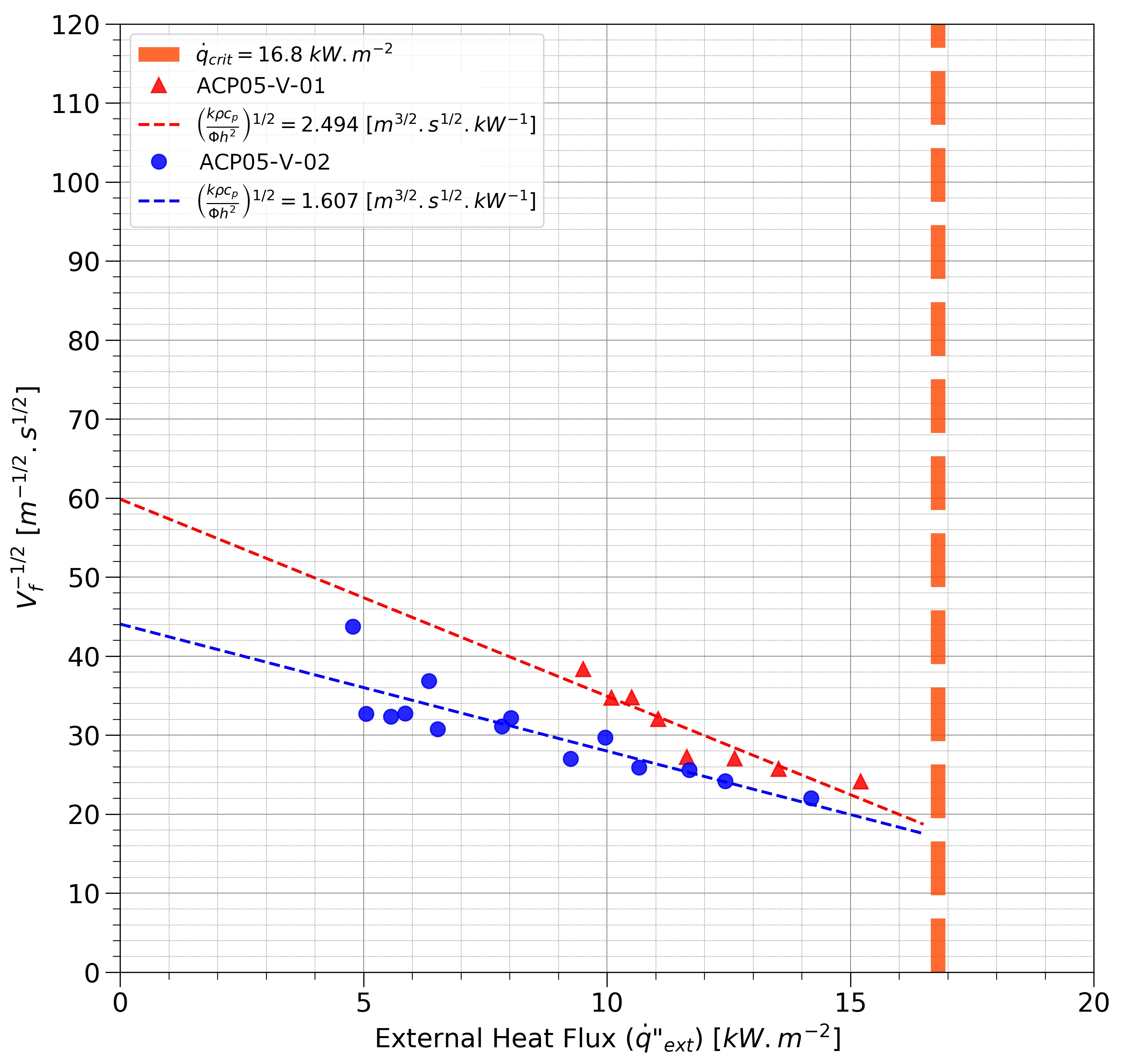
| Orientation | Trial | (kρcp⁄Φh2)1⁄2 [m3⁄2 s1⁄2 kW-1] | Φ [kW2 m-3] |
|---|---|---|---|
| Horizontal | 1 | 3.423 | 63.84 |
| Horizontal | 2 | 3.354 | 66.50 |
| Vertical | 1 | 2.494 | 120.07 |
| Vertical | 2 | 1.607 | 289.19 |